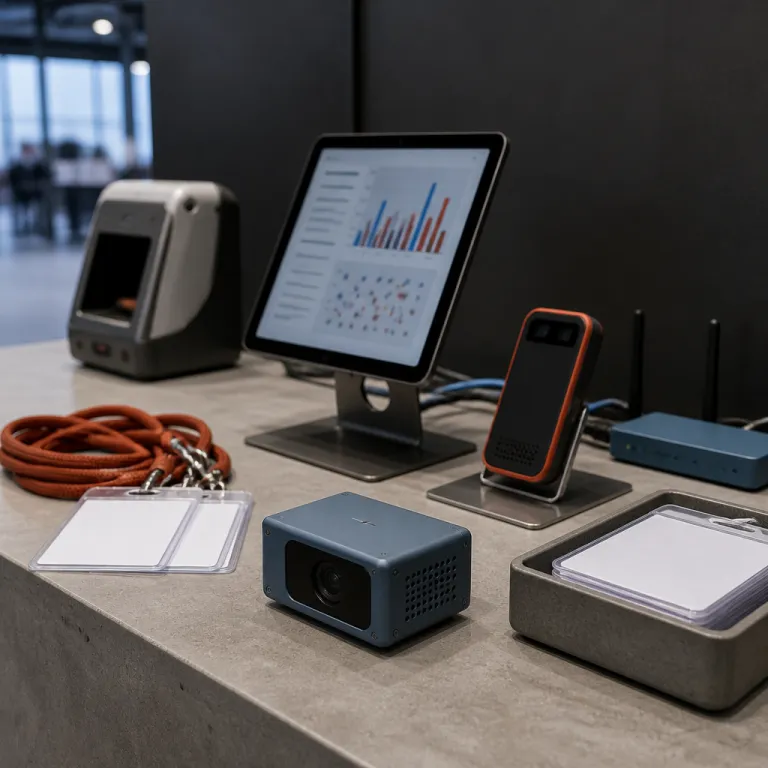
From badge scans to AI lead capture in UK B2B exhibitions
AI-driven lead capture strategies at UK B2B exhibitions are quietly rewriting how exhibitors think about pipeline from shows. Traditional badge scanning produced a raw lead list after the event, while modern capture platforms now deliver qualified prospects in real time directly into CRM systems for immediate follow up by sales teams. At ExCeL London and NEC Birmingham, exhibitors at major trade events are already shifting budget from hardware badge scanners to mobile capture apps that treat every event contact as a data rich profile rather than a name on a spreadsheet.
The core difference is that intelligent lead capture tools treat each interaction at the booth as conversation context to be analysed, not just a badge to scan. Instead of waiting for post event admin, exhibitor records are created instantly, enriched with lead data from business cards, badges and QR code scanning, and pushed into CRM platforms where sales teams can see trade lead quality scores before they leave the venue. This is where AI-enabled exhibition programmes start to outperform manual lead retrieval, because the technology turns fragmented event data into a coherent view of attendee intent and buying stage.
Vendors such as QLead, Popl and LeadsSnap now support universal badge scanning, business card capture and AI data enrichment in a single capture app. Independent tests of optical character recognition on business cards typically report accuracy rates in the mid-90 percent range under good lighting and print conditions, which sharply reduces manual correction by booth staff after events. Across hundreds of exhibitions and many thousands of visitors tracked, these AI-assisted lead retrieval tools have shown that when exhibitors treat capture as a real time data workflow rather than an end of day chore, the number of sales ready leads increases while the administrative burden on teams falls.
Three AI approaches: conversational, computer vision and predictive scoring
Behind the headline of AI adoption in exhibition lead capture sit three distinct technology approaches that UK marketing leaders need to evaluate. Conversational AI on stands uses chat style interfaces or voice assistants at the booth to guide each attendee through structured questions, capturing lead data, conversation context and explicit consent while freeing booth staff to handle higher value discussions. Computer vision systems mounted around the stand analyse traffic flows, dwell time and engagement with demos, turning anonymous visitor behaviour into aggregated data that can be correlated with later sales outcomes.
The third approach is predictive lead scoring based on engagement signals from capture apps, badge scanning, code scanning and content interactions across hybrid event formats. Here, AI models assign a trade lead score in real time using factors such as job role, sector, time spent at the booth, questions asked and assets downloaded, then sync that score into CRM records for prioritised follow up by sales teams. When combined with marketing automation, this predictive lead scoring allows exhibitors to trigger tailored nurture journeys for different lead segments within minutes of the event, rather than waiting for manual segmentation days later, which often kills momentum and reduces conversion.
For senior marketers, the practical question is where these AI tools justify their licence cost compared with a well briefed human team using a simple capture app. Conversational AI can be powerful at large trade shows such as UK Construction Week or Bett, where booth staff cannot speak to every attendee and virtual assistants can pre qualify visitors before a human steps in. Computer vision and predictive scoring tend to pay off when exhibitors run a multi event calendar and want consistent lead retrieval metrics, because the models improve as more events generate more lead data to train on, making each subsequent trade event more efficient.
For a deeper view on how rapid response shapes conversion, senior leaders should study the analysis on the five minute rule for post event lead response time, which shows that speed of follow up often beats sheer volume of leads. AI driven lead capture and lead retrieval systems are designed to support that speed by eliminating manual data entry and pushing clean, scored records into CRM platforms while the attendee is still on site. When AI tools, booth staff and sales teams align around that response window, the economic case for intelligent exhibition lead capture investments becomes much clearer.
CRM integration and the data bottleneck: why most event leads still die in spreadsheets
Even as AI-powered capture tools mature, CRM integration remains the weakest link in most UK event strategies. Many exhibitors still export leads from capture apps or badge scanning portals into spreadsheets, then rely on marketing or sales teams to upload them manually into CRM systems days after the event. That delay breaks the chain between event lead intent and sales follow up, and it often means that valuable conversation context from the booth is lost before anyone can act on it.
Modern platforms promise direct CRM synchronisation, but industry surveys consistently show that only a minority of organisations have fully integrated their event systems with sales and marketing platforms. The technical challenge is rarely the API itself; it is the messy reality of inconsistent lead data fields, multiple business units using different CRM instances and booth staff entering free text notes that do not map cleanly into structured data. When exhibitors treat AI-enhanced lead capture as a standalone event tool rather than part of a unified business data architecture, they end up with faster badge scanning and code scanning but the same old problem of fragmented leads that never convert into sales.
To break this pattern, UK marketing directors need to design event lead workflows from the CRM backwards. Start by defining the minimum viable lead qualification schema that sales teams will accept, including fields for buying stage, product interest, budget range and next step, then configure capture apps to enforce those fields at the booth so that every exhibitor lead is created in a CRM ready format. A simple checklist might include: Lead Status (New, MQL, SQL), Lifecycle Stage (Subscriber, Lead, Opportunity), Primary Product Interest, Estimated Budget, Decision Timeframe, Job Role / Seniority, Industry and Agreed Next Action. In Salesforce, for example, Product Interest can map to a custom field on the Lead object, while in HubSpot it can map to a custom contact property used for segmentation. Align marketing automation journeys with those fields so that real time lead scoring can trigger specific nurture tracks, and insist that any AI lead capture vendor demonstrates live CRM write back at a pilot event before signing a multi event contract.
There is also a strategic angle here for brands investing heavily in UK trade events and conferences. When capture data flows cleanly into CRM, it becomes possible to attribute pipeline and revenue back to specific shows, stands and sponsorships, which sharpens decisions about where to invest next season and how to negotiate packages with organisers. For a practical playbook on aligning stand traffic, pre show outreach and sponsorship, many CMOs now reference the pre show outreach framework that lifts booth traffic, then layer AI driven lead retrieval on top to ensure that every extra attendee at the booth is captured, scored and followed up.
Privacy, consent and the UK regulatory lens on AI event data
AI-enabled exhibition strategies do not operate in a legal vacuum, especially in the UK where data protection rules are tightening around AI driven profiling. Recent and forthcoming legislation extends consent and transparency obligations to automated decision making systems that profile individuals based on behavioural data from events. That means any AI lead retrieval or lead scoring engine that uses booth interactions, dwell time or conversation context to prioritise leads must be clearly explained to the attendee at the point of data capture, not buried in a generic privacy notice.
For exhibitors, this shifts privacy from a back office compliance task to a front line booth design issue. Capture apps need to present concise consent language on tablets or phones when scanning a badge or business card, and booth staff must be trained to explain how lead data will be used, how long it will be retained and which CRM or marketing automation systems it will feed. Where virtual or hybrid event platforms are involved, the same standards apply to digital badge scanning, code scanning and content tracking, because the law focuses on the nature of the profiling rather than whether the interaction happened at a physical booth or in a virtual environment.
AI vendors are responding with features such as consent logging, granular preference management and audit trails that show exactly when and how each event lead was captured. Tools like QLead and Popl emphasise that they support scanning of business cards, badges and QR codes while maintaining clear consent records, and they highlight that AI enrichment provides comprehensive visitor profiles without resorting to opaque third party data brokers. For UK CMOs, the practical test is whether an AI-focused exhibition stack can generate a complete, exportable record of consent and processing purposes for every attendee, because without that, the commercial upside of real time lead capture could be wiped out by regulatory and reputational risk.
When AI beats humans at lead capture – and when it does not
Not every AI deployment for exhibition lead capture is worth the licence fee, and senior marketers need a clear framework for deciding when software will outperform a well trained human team. Automation shines in high volume trade shows where booth staff cannot realistically hold deep conversations with every attendee and where universal badge scanning, business card capture and automated lead retrieval prevent leakage. It also excels in hybrid event formats where virtual and physical interactions must be stitched together into a single view of the attendee journey, something that manual processes simply cannot achieve at scale.
However, there are still many UK business events where a focused human led approach to lead qualification will beat any capture app. At smaller, high value conferences such as sector specific leadership summits in London or Manchester, the number of leads is limited and the quality of conversation context matters more than the speed of badge scanning, so a simple capture app feeding structured notes into CRM may be sufficient. In these settings, the priority is to brief booth staff thoroughly on qualification criteria, next step commitments and post event responsibilities, then use lightweight tools to ensure that every event lead is logged accurately and followed up quickly by sales teams.
The most effective exhibitors blend both approaches, using AI to handle the mechanics of lead capture, lead scoring and data enrichment while empowering humans to build trust and shape the narrative. They treat intelligent capture tools as infrastructure for real time data processing, not as a substitute for commercial judgement or relationship building. As one industry case study from QLead notes, “QLead implemented AI lead capture at a major trade show. Achieved 95% OCR accuracy and streamlined lead processing.”
For brands investing heavily in sponsorships and large booths at venues such as Olympia London or the Scottish Event Campus, the next step is to align AI lead capture with broader brand and pipeline objectives. That means integrating AI tools into pre show outreach, on stand engagement and post event nurture, while also using them to measure the impact of sponsorship choices outlined in analyses of strategic event sponsorship for brand visibility. In the end, what matters to the board is not the badge scan count, but the deal that followed.
FAQ
How does AI lead capture differ from traditional badge scanning at exhibitions ?
Traditional badge scanning simply records that an attendee visited your booth, often storing only basic contact details for later export into spreadsheets. AI lead capture combines badge scanning, business card capture and behavioural signals to create enriched lead profiles in real time, including qualification data, interests and engagement history. This enriched lead data is then pushed directly into CRM and marketing automation systems, enabling immediate follow up and more accurate lead scoring.
What should UK exhibitors look for when choosing an AI lead capture tool ?
UK exhibitors should prioritise tools that offer universal badge scanning, accurate business card recognition and robust CRM integration with clear data mapping. It is also important to assess whether the capture app supports both physical and virtual or hybrid event formats, and whether it can handle consent logging in line with UK data protection rules. Finally, marketing leaders should test how well the tool captures conversation context from booth staff, because that qualitative insight often drives better lead qualification and sales outcomes.
How does AI powered lead scoring work in a B2B exhibition context ?
AI powered lead scoring uses algorithms to evaluate each event lead based on multiple signals such as job role, company size, content consumed, time spent at the booth and responses to qualification questions. These models assign a score that reflects the likelihood of conversion, allowing sales teams to prioritise follow up on the most promising leads first. Over time, as more events generate more lead data, the scoring models improve, making predictions more accurate and helping exhibitors refine their event strategies.
Are AI lead capture tools compliant with UK data protection and privacy laws ?
AI lead capture tools can be compliant with UK data protection laws, but only if they are configured correctly and used with transparent consent practices. Exhibitors must ensure that attendees understand how their data will be used, especially when AI is involved in profiling or automated decision making, and they must maintain clear records of consent and processing purposes. Working closely with legal and data protection teams, and selecting vendors that provide strong consent management features, is essential for compliant deployment.
When does it make sense to rely mainly on human led lead capture instead of AI ?
Human led lead capture can be more effective at smaller, high value events where the number of attendees is limited and the depth of each conversation is critical. In such settings, a well briefed booth team using a simple capture app to log structured notes into CRM may deliver better results than a complex AI stack. The key is to match the sophistication of the technology to the scale and strategic importance of the event, rather than adopting AI for its own sake.