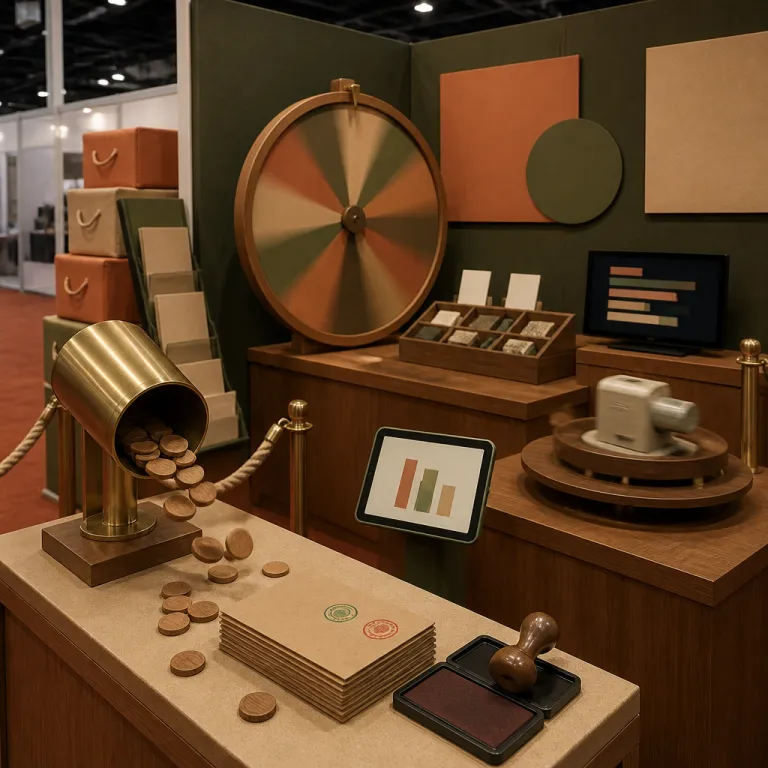
Why traditional giveaways damage lead quality at B2B exhibitions
Most UK B2B exhibitors still treat every event as a volume game. Prize draws, generic swag and digital spin-to-win activities create surface-level engagement, but they mainly attract attendees who will never enter your pipeline. When exhibition engagement tactics are built around free gifts rather than business problems, you pay for noise instead of qualified conversations.
Look at any large trade exhibition at ExCeL London or the NEC and you will see the pattern. The booths with the longest queues often report the weakest sales performance, because their engagement strategies reward anyone willing to queue rather than the customer with a real project and budget. Traditional event marketing has trained visitors to treat the exhibition floor as a marketplace for tote bags, not a forum for serious trade discussions.
Industry research from CEIR and similar bodies consistently shows that most visitors have some buying influence, yet only a fraction ever become opportunities. For example, the CEIR Exhibitor ROI and Performance Metrics study (2019) found that around 80% of attendees have buying authority, but typical opportunity conversion rates sit closer to 20–25%. Interactive experiences can add several minutes of dwell time compared with passive displays, but that extra time only matters when the interaction filters for intent instead of inflating badge scans. With a majority of attendees at many B2B events holding at least recommending authority, the real missed opportunity is not traffic, but the lack of a marketing strategy that separates decision makers from prize hunters.
Giveaway-led event tactics also distort how teams read performance. A busy trade booth can mask weak lead capture discipline, shallow customer engagement and poor qualification, leaving sales to sort through hundreds of low-value contacts after the exhibition. The result is a post-event hangover where marketing management claims success on footfall, while sales leaders quietly downgrade the event in next year’s budget discussions.
For UK businesses under pressure to justify every line of event promotion spend, this is no longer sustainable. Exhibition industry costs have risen, while travel and accommodation for events in London, Birmingham or Manchester eat into margins faster than before. The only rational response is to treat each exhibition as a pipeline acceleration asset, where engagement ideas are judged by revenue influence, not by how many user-generated photos of branded hoodies appear on social media.
Challenge based engagement that qualifies real buyers
The shift in exhibition engagement tactics for B2B marketers is away from random fun and towards structured challenges that surface real projects. Instead of a generic quiz, leading UK exhibitors now deploy product configurators, problem-solving scenarios and live benchmarking tools that turn engagement into a working session. These activities feel like consultancy, not entertainment, and they naturally lead into deeper conversations about scope, budget and timelines.
At a manufacturing conference series in Birmingham, one automation vendor replaced its prize draw with a line design challenge. Attendees used a tablet-based configurator at the booth to map their current production flow, then compared it with an optimised version generated in real time by the system. The engagement strategy here was simple but powerful, because only visitors with genuine operational responsibility invested the time to complete the exercise.
Gamified diagnostics work equally well in software and services. For instance, cyber security firms such as Sophos and Trend Micro at Infosecurity Europe have used live risk assessment games, where attendees answer scenario-based questions and receive a benchmark score against peers at similar events. This kind of content turns abstract marketing into concrete experiences, while giving the sales team structured lead capture data on sector, stack and urgency.
For your own marketing strategy, design challenges that mirror the decisions your buyers already make. A pricing optimisation game for revenue leaders, a route-planning simulator for logistics directors or a compliance checklist race for regulated industries can all anchor customer engagement in real business stakes. The key is that the game mechanics reward clarity of need, not random participation, so your post-event follow-up focuses on qualified, problem-aware contacts.
Challenge-based formats also create rich generated content for later use. Screenshots of benchmark dashboards, anonymised heatmaps of common pain points and aggregated scores by sector can all feed into post-event nurture, such as a structured 30-day sequence that turns event leads into booked meetings. When every interaction at the exhibition generates useful data and content, your event budget stops being a one-off spend and becomes an engine for ongoing pipeline momentum.
Competitive formats that extend dwell time without cheapening the brand
Competition is a powerful lever in B2B exhibition engagement, but only when it is framed around expertise rather than luck. Leaderboards, timed challenges and team exercises can significantly increase dwell time at your booth, yet still feel aligned with a premium brand. The difference lies in what you ask attendees to compete on and how that competition links to your value proposition.
At London Tech Week, several SaaS vendors have run timed workflow optimisation challenges on large touchscreens, where attendees race to configure a process in the fewest clicks. This kind of interaction creates a visible crowd around the trade booth, but the activity itself demonstrates product capability and sparks informed conversations about integration and change management. It is a far cry from the old model of spinning a wheel for a coffee voucher, which tells a serious buyer nothing about your business.
Physical team exercises can work just as well in more traditional trade exhibitions. An engineering supplier at Subcon used a collaborative build challenge, where small teams assembled a component against the clock using different tool sets, then compared performance metrics on a leaderboard. The experiences were playful, but the debrief focused on total cost of ownership, safety and maintenance time, keeping the engagement anchored in commercial outcomes.
Digital leaderboards also create strong social media moments without resorting to gimmicks. Attendees photograph their ranking, share it with colleagues and generate user-generated posts that extend your event promotion beyond the exhibition hall. Crucially, the generated content here showcases your solution in action, rather than just another pile of branded stress balls.
To make these competitive formats work, design the booth layout around a clear visitor flow. Curiosity at the edge, then a visible challenge zone, then a quieter space for one-to-one conversations, as highlighted in many analyses of stand design as a conversion lever. When the physical exhibition space guides attendees from spectacle to substance, your engagement strategy stops being a sideshow and starts functioning as the front end of a disciplined sales process.
From game to qualified lead: data, scoring and ROI
The real power of modern exhibition engagement lies in the data it generates. Every quiz answer, configuration choice or challenge score can become a qualification signal, provided you design the experience with lead capture in mind. Without that structure, you simply swap one kind of vanity metric for another.
Start by defining what a sales-ready contact looks like for your business at a specific event. For a cloud provider at a London conference, that might mean attendees with more than 500 employees, a defined migration timeline and a current contract expiry within twelve months. Your interactive activities should then be built to surface these attributes naturally, rather than bolting on a generic form at the end.
Interactive quizzes are particularly effective when they double as discovery tools. A medical technology exhibitor at a UK healthcare exhibition used a short clinical workflow quiz that produced tailored recommendations on screen, while quietly tagging each response in the CRM as a buying signal. The organiser’s post-show report noted that the most successful gamification initiatives “aligned with the target audience’s interests and needs” and that prizes worked best when they were professionally relevant, which neatly summarises the mindset required.
To turn this into measurable ROI, agree a simple scoring model before the event. For example, assign points such as: role seniority (0–20), project urgency (0–30), budget clarity (0–20) and engagement depth (0–30). A participant might score 15 for being a director-level decision maker, 25 for an active project within six months, 10 for having an indicative budget and 20 for completing multiple challenge stages, giving a total of 70. Use the total score to prioritise post-event follow-up and post-marketing campaigns, with clear thresholds for MQLs (for instance, 60+ points) and immediate sales outreach (for example, 80+ points).
Finally, connect your exhibition data to broader marketing strategy and budgeting decisions. Insights from one show should inform pre-marketing for the next, from which engagement ideas to repeat to how much to allocate to different cost lines in a structured exhibition budget breakdown. Over time, this feedback loop lets UK exhibitors shift from anecdotal judgments about events to a portfolio view, where each exhibition is assessed on pipeline created per hour of staff time, not just on headline attendance figures.
Staffing models and handoffs: turning play into pipeline
Even the smartest B2B engagement concepts will fail if the staffing model is wrong. Gamification can reduce the need for senior salespeople to handle every initial interaction, but it does not remove the need for timely, expert conversations. The art lies in orchestrating the handoff from game to business discussion without breaking the experience.
Think of your booth team in three layers. At the front, engagement hosts manage the activities, explain the rules and encourage participation, often handling multiple attendees in real time. Behind them, product specialists and sales leaders step in when a participant’s behaviour or data score indicates serious intent, ensuring that high-value attendees are not left waiting while the team resets a screen or refills a prize bowl.
Clear scripts and visual cues make this handoff smoother. For example, when a participant reaches a certain benchmark score in a challenge, the system can trigger a subtle notification on a staff tablet, prompting a nearby salesperson to join the conversation. This keeps the flow natural for the customer, who experiences a seamless shift from playful activity to tailored advice, rather than a jarring switch into hard-sell mode.
Training is critical, especially for UK teams that only work together at a few events each year. Run internal dry runs of your engagement strategy before major trade exhibitions, so staff understand not just the mechanics of the game, but the commercial narrative that follows. Emphasise that the goal is not to push every attendee into a meeting, but to identify which experiences signal real buying cycles and then invest time accordingly.
After the exhibition, close the loop with a disciplined review of both human and digital performance. Analyse which staff shifts produced the strongest sales outcomes, which engagement activities generated the most qualified leads and how quickly post-event follow-up converted to meetings. Over several events, this operational discipline turns gamification from a novelty into a repeatable system for pipeline creation, where success is measured not by the badge scan count, but by the deal that followed.
FAQ
How can I ensure gamification attracts decision makers, not just prize hunters ?
Anchor every game mechanic in a real business problem that only serious attendees will invest time to solve. Use challenges that require knowledge of budgets, processes or strategy, and make the reward something professionally valuable, such as a tailored benchmark or consultation. This naturally filters for decision makers and turns engagement into a pre-qualification step.
What metrics should I track to measure ROI from gamified exhibition activities ?
Track dwell time, completion rates, qualification scores and the conversion of participants into meetings and opportunities. Compare these metrics with non-gamified interactions at the same event to understand incremental impact on pipeline. Over several events, you can then benchmark which formats consistently deliver the strongest commercial outcomes.
Do competitive games risk cheapening a premium B2B brand ?
They only do so when the competition is unrelated to your value proposition or feels gimmicky. Design leaderboards and timed challenges around tasks that showcase your expertise, such as optimisation, diagnostics or strategic decision making. When the competition demonstrates competence rather than luck, it reinforces rather than dilutes a premium positioning.
How should I integrate gamification data into my wider marketing strategy ?
Feed all structured responses and scores into your CRM, tagging them as behavioural signals alongside traditional firmographic data. Use these insights to refine pre-event targeting, personalise post-event nurture and prioritise sales outreach. Over time, patterns in this data should inform which events you attend and which engagement formats you scale.
Is gamification suitable for smaller booths and niche B2B events ?
Yes, provided the mechanics match your space and audience. Simple tablet-based diagnostics or one-to-one configuration challenges can work well on compact stands at specialised conference gatherings. The goal is not spectacle, but focused engagement that surfaces real projects and supports high-quality conversations.